

Water vs. Oil Mold Temperature Controllers: How to Choose for Injection Molding
Should your mold temperature controller use water or oil? It comes down to the operating mold temperature your resin demands. Water units transfer heat faster, shorten cycle times, and keep shop floors clean, with pressurized closed-loop circuits pushing that efficiency up to 180°C (356°F). Thermal oil takes over once processing requires 200°C (392°F) or higher. Choosing the wrong medium leads to premature heater burnout, excessive cycle delays, or contaminated parts. The breakdown below details where each medium excels and how to identify the exact threshold for your tooling.
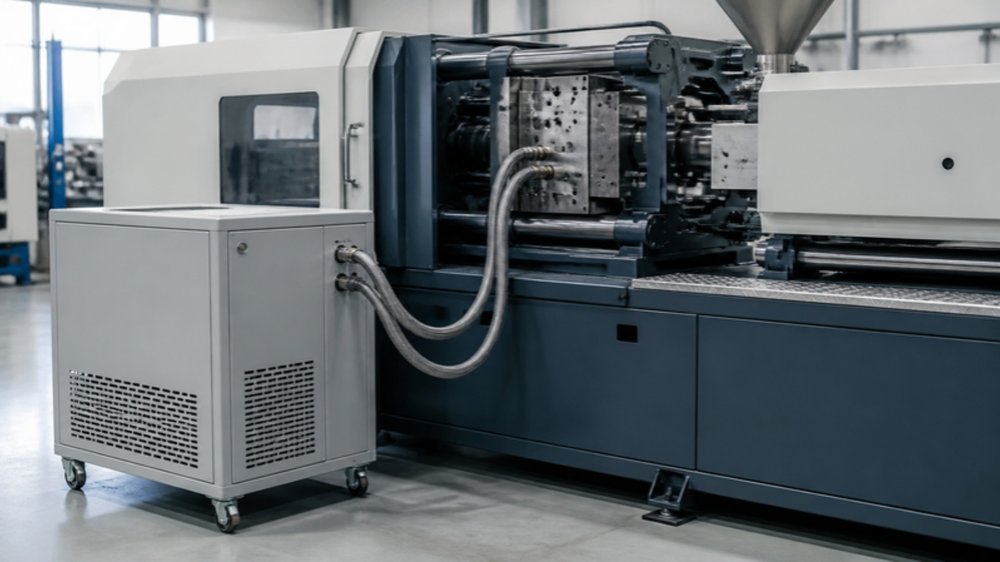
What a Mold Temperature Controller Does, and Why the Heat-Transfer Medium Matters
A mold temperature controller—commonly referred to as a temperature control unit (TCU) or mould temperature controller—circulates a fluid medium through internal mold cooling channels to bring tooling to operating temperature and maintain steady thermal equilibrium throughout production runs.
Stable mold temperature directly governs part quality. Maintaining proper thermal control prevents surface defects such as sink marks, weld lines, and warpage, while ensuring uniform resin shrinkage and high optical clarity in transparent parts. The system operates via a continuous closed loop: an internal heater brings the circulating medium to target temperature, a heavy-duty pump drives fluid through the mold channels, and return lines channel hot fluid back through an indirect heat exchanger (plate cooler) whenever the process requires cooling.
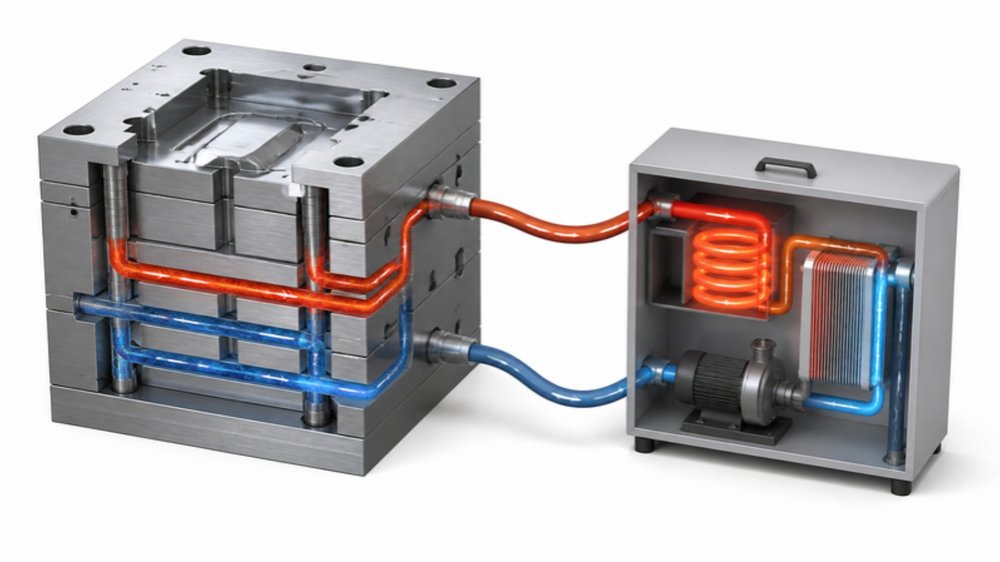
Because fluid physical properties dictate heat transfer rates and operating limits, selecting between water and thermal oil sets the baseline performance of your entire molding cell.
Water vs. Oil Mold Temperature Controllers: Side-by-Side Comparison
While both equipment types serve the same fundamental purpose, their thermal dynamics, pressure profiles, and maintenance requirements differ significantly.
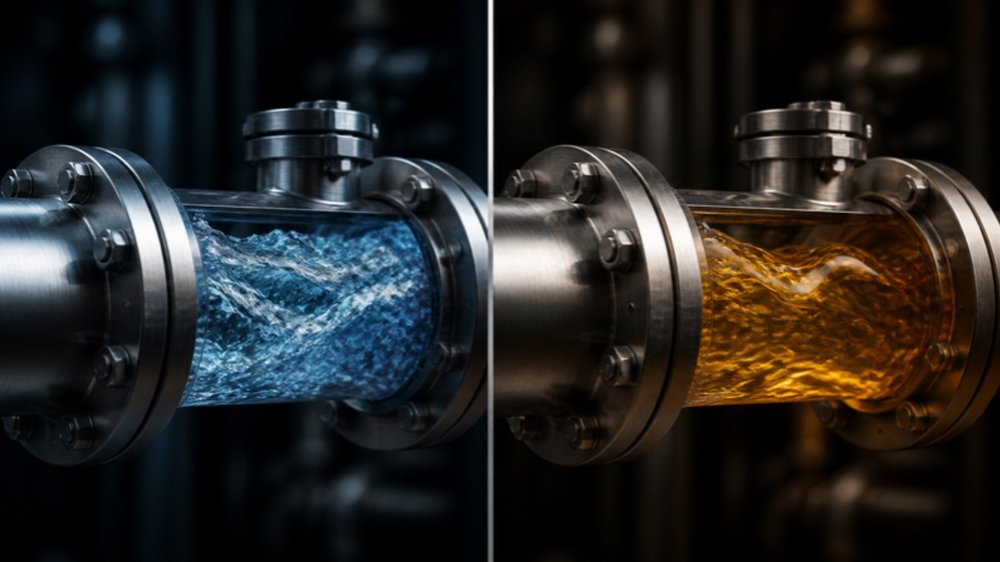
The following matrix highlights the operational trade-offs between water and oil circuits across standard industrial injection molding applications:
| Evaluation Factor | Water Mold Temperature Controllers | Oil Mold Temperature Controllers |
|---|---|---|
| Operating Temperature Range |
Standard: Up to 120°C (248°F) Pressurized Water: Up to 180°C (356°F) |
Standard: Up to 200°C (392°F) High-Temp: Up to 300°C (572°F) Ultra-High: Up to 350°C (662°F) |
| Thermal Conductivity & Heat Transfer | Exceptionally high specific heat capacity; rapid heating and cooling response times | Moderate heat capacity; slower thermal response, requiring longer warm-up times |
| Operating Pressure | Requires high-pressure closed circuits above 100°C to prevent boiling | Operates at low system pressures even at elevated temperatures |
| Corrosion & Scale Risks | Susceptible to mineral scale and channel rust if water is untreated | Non-corrosive; circulating oil naturally lubricates and inhibits internal oxidation |
| Maintenance & Operating Cost | Inexpensive fluid replacement; routine descaling and filtration upkeep | Regular thermal oil replacement required due to thermal cracking; higher fluid cost |
| Plant Cleanliness & Safety | Clean operation; zero volatile fumes, smoke, or slippery oil residues | Requires leak mitigation; hot oil mist poses slip hazards and optical part contamination |
Matching Mold Temperature to the Right Controller: A Resin-by-Resin Guide
Selecting a controller starts with the mold surface temperature specified by your resin supplier rather than the cylinder barrel temperature.
To help processors determine the correct system configuration, the table below maps typical resin temperature thresholds to corresponding Shini controller series:
| Required Mold Temperature | Recommended Controller Series | Typical Engineering Resins |
|---|---|---|
| Below 120°C (248°F) | STM-W Series (Standard Water) | PP, PE, ABS, PS, standard PC, PA6, PA66, POM |
|
120°C to 180°C (248°F to 356°F) |
STM-PW Series (Pressurized Water) or STM Series (Oil) | Glass-filled Polyamides (PA6/66-GF), PPS, low-temp PEI |
|
180°C to 200°C (356°F to 392°F) |
STM Series (Standard Oil) | High-temperature Polysulfone (PSU), Polyaryletherketone blends |
|
200°C to 300°C (392°F to 572°F) |
STM-HT Series (High-Temp Oil) | PEEK, LCP, PEI (Ultem™), Fluoropolymers |
|
300°C to 350°C (572°F to 662°F) |
STM-SHT Series (Ultra-High-Temp Oil) | Specialized aerospace polymers, advanced carbon-composite molding |
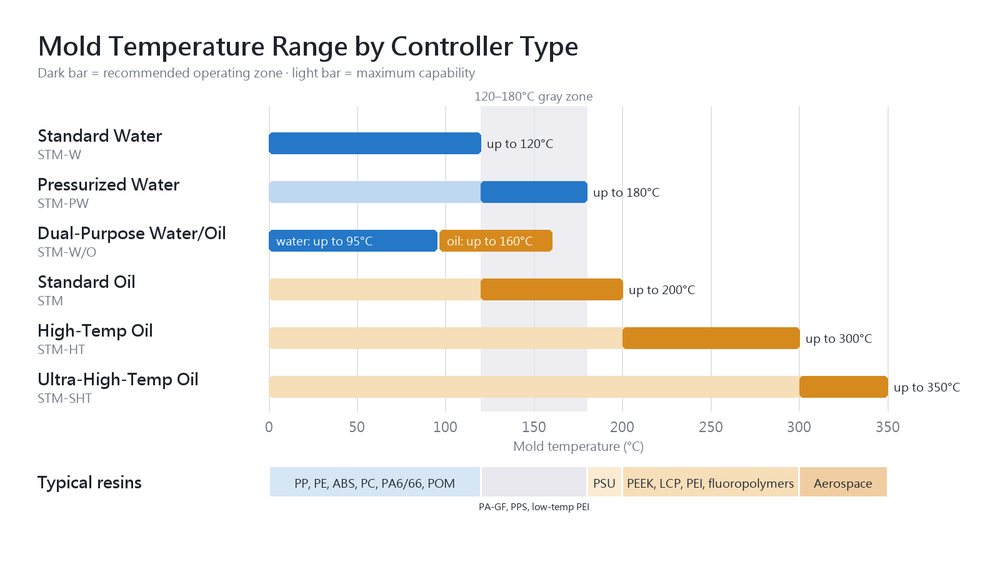
A common misconception in injection molding facilities is that unfilled Polycarbonate (PC) or Polyamide (Nylon) automatically demands an oil controller. In standard molding environments, PC tool temperatures range between 80°C and 110°C, meaning standard water units like the STM-W handle them with faster cycle cooling.
Conversely, high-performance polyaryletherketones like PEEK require tool temperatures of 160°C to 200°C to achieve full semi-crystalline morphology. Because running a 180°C pressurized water unit continuously at its mechanical ceiling leaves zero safety margin, high-temperature oil controllers such as the STM-HT provide the requisite thermal headroom.
The 120–180°C Gray Zone: Pressurized Water or Oil?
Tooling temperatures between 120°C and 180°C represent an overlapping operational zone where both pressurized water systems and standard oil heaters function reliably. Deciding between them depends on your facility's cycle time priorities, plant utilities, and part cleanliness standards.
Pressurized water controllers (such as the Shini STM-PW series) maintain water in a liquid state up to 180°C by keeping the internal loop pressurized up to several bar. Because water has more than double the specific heat capacity of mineral heat-transfer oil, water circuits extract heat out of tool walls significantly faster during the cooling phase. For high-volume technical molding—such as automotive electrical connectors or precision electronic housings—pressurized water cuts cycle times by several seconds compared to thermal oil. Furthermore, in medical cleanrooms or optical production, pressurized water eliminates oil vapors that fog lens surfaces.
On the other hand, thermal oil operates within this range under low internal line pressures, reducing hydraulic stress on mold fittings, hoses, and rotary unions. If your facility operates with untreated well water prone to severe calcium carbonate scaling, or if you anticipate upgrading tool configurations to run higher-temperature resin grades in the future, standard oil units offer broader mechanical forgiveness.
Where a Dual-Purpose Water/Oil Controller Fits, and Where It Doesn't
A dual-purpose controller provides flexible medium switching for contract molders running diverse job runs, but it comes with distinct thermal limits.
Units such as the STM-W/O Series feature vertical dual-use pumps and dual piping circuits engineered to handle the differing viscosities of water and heat transfer oil. In water mode, the machine operates up to 95°C (203°F); in oil mode, it handles temperatures up to 160°C (320°F).
This dual-use architecture serves contract injection molding shops that frequently switch between low-temperature commodity jobs (such as polypropylene packaging) and moderate-temperature engineering resins without purchasing separate machines.
However, dual-purpose units are not universal high-temperature machines. Because oil mode caps out at 160°C, an STM-W/O cannot process advanced polymers like PEEK, PPS, or high-fill polyamides requiring tool temperatures above 170°C. Treating a dual-purpose unit as a replacement for high-temperature oil equipment will result in incomplete polymer crystallization and surface defects.
Beyond Temperature: Flow Rate and Heating Capacity Also Shape the Choice
Matching temperature limits solves only half the specification equation; maintaining turbulent fluid flow and sizing total heating wattage determine day-to-day part consistency.
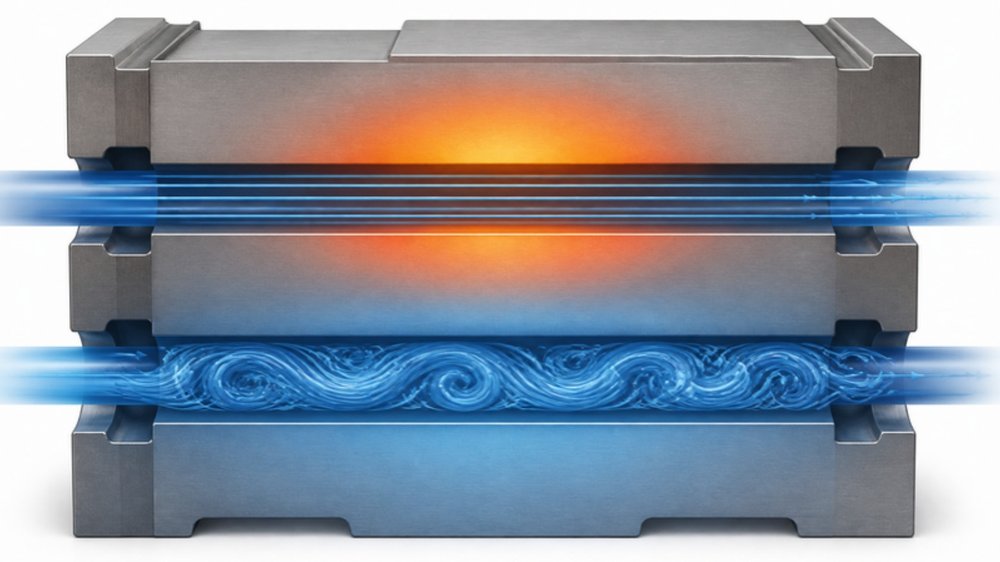
Mold channels must sustain turbulent flow (typically defined by a Reynolds number exceeding 4,000) to strip boundary heat away from steel channel walls efficiently. If mold circuits are lengthy, narrow, or incorporate restrictive conformal cooling inserts, standard pumps may experience pressure drop, resulting in laminar flow and localized mold hot spots. For high-cavitation or restrictive tooling, large-flow units such as the STM-WF or STM-PWF series provide the high pumping pressure needed to overcome line resistance.
Similarly, heating capacity (measured in kilowatts) dictates how rapidly a mold reaches steady-state temperature from a cold startup. Sizing heater power requires factoring total mold steel weight, ambient heat dissipation, target cycle speed, and whether multi-zone control is required:
-
Mold Steel Mass:
Large tools demand higher kilowatt ratings to reach operating temperatures within practical startup windows (typically 30–60 minutes). -
Dual-Zone Requirements:
Complex parts with differential core/cavity cooling requirements benefit from dual-zone controllers (such as the STM-W-D, STM-PW-D, or STM-D), which house two independently controlled circuits inside a single compact frame.
Because mold geometry, internal loop diameter, and shot weights vary across every tool build, calculating exact pump displacement and heating wattage requires dedicated system engineering.
Water vs. Oil Mold Temperature Controller FAQ
Before finalizing equipment procurement, injection processors frequently evaluate these practical operational questions:
Can a water mold temperature controller operate above 100°C?
Yes. By circulating water through a sealed, hermetically closed circuit under pressure, systems like the Shini STM-PW prevent atmospheric boiling, operating reliably up to 180°C (356°F) while maintaining rapid heat exchange.
Do unfilled Polycarbonate (PC) and Nylon (PA) require an oil controller?
No. Standard unfilled PC and Nylon generally specify mold surface temperatures between 80°C and 110°C. Standard water controllers operating up to 120°C handle these resins efficiently without the higher fluid cost of thermal oil.
What mold temperature controller is required for PEEK?
PEEK requires high-temperature oil controllers capable of maintaining stable mold steel temperatures between 160°C and 200°C. The Shini STM-HT series (up to 300°C) is recommended to ensure robust thermal headroom and complete part crystallization.
Is a dual-purpose water/oil controller suitable for all engineering resins?
No. Dual-purpose controllers like the STM-W/O operate up to 95°C in water mode and 160°C in oil mode. They excel at multi-resin versatility across medium-temperature jobs, but cannot support ultra-high-temperature polymers requiring 180°C or higher.
Can an existing oil controller be refilled with water?
No. Standard oil units feature internal pump seals, heating element densities, and pipe valving designed specifically for oil viscosity. Running water in a dedicated oil circuit damages pump seals, promotes internal corrosion, and voids machine safety compliance.
Get a Tailored Mold Temperature Controller Recommendation from Shini Engineers

Selecting the ideal heating medium and pump specification prevents costly cycle delays and premature tooling wear. Shini technical specialists evaluate your mold steel mass, resin specifications, cycle targets, and plant utility constraints to recommend the optimal controller configuration.
To review sizing calculations for your tooling, contact Shini technical support with your mold specifications, or explore our complete lineup of auxiliary heating and cooling systems.